OUR WORK IS MADE POSSIBLE BY THE SUPPORT OF OUR FUNDERS:
IN COOPERATION WITH:
THANK-YOU FOR THE SUPPORT:






Effect of AC Loads - Webinar Notebook
This data release is the open-data companion to A2EI Technical Note Issue 02 (Effect of AC Loads on Solar Generators, February 2026). The technical note investigates why hybrid solar generators installed as backup power supplies in Nigeria show high failure rates, identifies the connected loads as one of the main root causes, and derives both circuit-level and installation-level countermeasures. To make the underlying load portfolio reusable for manufacturers, distributors and researchers, this data release publishes a selected set of measurements that were collected and processed in the study: 20 typical AC loads from households and small businesses in Abuja, their characteristic parameters, and the recorded current and voltage waveforms together with their reproductions on a programmable Cinergia EL+20 AC load.1. Load Classification Table
The 20 loads documented here were measured at customer sites in Abuja, Nigeria (small businesses such as a tailor's shop, a hairdresser, a bakery, a photo studio, and a barber shop, as well as private households) and at the Chromevolt office. For each load, current and voltage were recorded at the load input from start-up until steady state using a 100 MHz oscilloscope, a current clamp, and a differential voltage probe. To preserve realistic conditions, the cabling and grid impedance present at each site were left unchanged, which means that the inrush currents reported below are what an inverter would actually see when supplying that specific installation, not idealised laboratory values.
The table consolidates the nameplate information (brand, model, ratings) where available, alongside the testing situation and five characteristics that are useful to reproduce a load on a programmable AC source: constant load (steady-state RMS current), inrush current and its duration, transients during steady-state operation, and phase shift (inductive, capacitive, or resistive). For some loads no nameplate was visible, in which case the affected fields remain empty. Inrush currents above 18 A are highlighted in yellow and above 28 A in red, since these magnitudes were found to challenge typical hybrid inverters in the 500–3000 W output range. The transient columns are highlighted whenever the load showed sudden current peaks that fall outside the regular 50 Hz sine wave, a rare but particularly damaging behaviour, observed for instance in a second-hand water pump (peaks up to 92 A) and a microwave (68 A).
The table is interactive: clicking on any row scrolls down to the corresponding waveform plots in chapter 4.
| Name | Brand | Model | Rated Power | Purpose | Rated Voltage in V | Rated Current in A | Testing Situation | Inrush Current in Apeak | Inrush Duration in s | Switch-on Transients | Other Transients | Power Factor | Constant Load in ARMS | Location | Power Supply | Repetitions | |
|---|---|---|---|---|---|---|---|---|---|---|---|---|---|---|---|---|---|
| Nr. | |||||||||||||||||
| 1 | Printer | HP | Color Laser MFP 179fnw | 300 W (printing); 38 W (ready); 1.9 W (sleep); 0.2 W (manual off) | small business | 220 - 240 | Printer is on, printing a page | 33.60 | 0.50 | 33.60 | ~0 | 4.20 | Chromevolt Office | 3kW Inverter | 10 | ||
| 2 | Sewing Machine 1 | EMEL | EM250-JM (motor), EM 6-9 (machine head) | 250 W | small business | 220 | 2.0 | 1. Connecting motor to AC (Activation moment) 2. Powering motor | 10.40 | 0.32 | 10.40 | inductive | 1.40 | Wuze Market | Grid | 12 | |
| 3 | Sewing Machine 2 | QD8636 | small business | 220 | 1. Connecting motor to AC (Activation moment) 2. Powering motor | 21.60 | 0.08 | 21.60 | inductive | 1.60 | Wuze Market | 1kW Inverter | 1. 5 2. 7 | ||||
| 4 | Drill | small business | 1. Connecting to AC and powering by hand 2. Connect to AC at full power | 22.40 | 0.23 | inductive | 3.30 | 1. Wuze 2. Chromevolt Office | 1. 1kW Inverter 2. 3kW Inverter | 1. 3 2. 5 | |||||||
| 5 | Bench Grinder | small business | Startup Moment of Motor | 2.40 | 12.24 | inductive | 0.70 | Wuze Market | Grid or Fuel Generator | 6 | |||||||
| 6 | Hair Dryer | OGM-RMHD-001 | 3500 W | small business | Startup Moment at highest power | ~0 | 8.90 | Hairdresser Abuja | 2kW Inverter | 4 | |||||||
| 7 | Hair Flat Iron | small business | Startup Moment | ~0 | 3.50 | Hairdresser Abuja | 2kW Inverter | 4 | |||||||||
| 9 | Hair Drying Hood | POSH INT'L CO. LTD | GPS5 | 630 W | small business | 220 - 240 | Startup Moment | ~0 | 1.70 | Hairdresser Abuja | 2kW Inverter | 6 | |||||
| 10 | Hair Curling Iron | small business | Startup Moment | ~0 | 5.70 | Hairdresser Abuja | 2kW Inverter | 5 | |||||||||
| 11 | Foot Bath | Scholl | Plus | household / small business | Startup Moment | ~0 | 3.00 | Hairdresser Abuja | 2kW Inverter | 5 | |||||||
| 12 | Freezer | Haier Thermocool | HTF-719HB | 300 W | household / small business | 220 - 240 | 2.4 | Startup Moment | 21.20 | 1.03 | inductive | 1.90 | Ushapa Food Shop | 3kW Inverter | 10 | ||
| 13 | Fridge | Newcastle | unknown (450L beverage chiller, 4-step) | small business | 1. internal switch 2. constant load | 16.40 | 0.43 | inductive | 1.80 | Ushapa Food Shop | Grid | 3 | |||||
| 14 | Gas Oven | small business | 1. Startup 2. constant load (heating works with gas) | ~0 | 0.90 | Ushapa Bakery | Grid | 2 | |||||||||
| 15 | Bread Slicer | 250 W | small business | 220 | 5 x Startup 1 x constant load 1 x turn-off moment | 40.80 | 0.08 | inductive | 3.40 | Ushapa Bakery | Grid | 7 | |||||
| 16 | Photo Flash | Godox | DE400 | 400 W (flash energy, not continuous) | small business | 220 - 240 | Startup | 13.00 | 1.02 | capacitive | 0.00 | Ushapa Photo Shop | 3kW Inverter | 5 | |||
| 17 | Towel Heater | POSH INT'L CO. LTD | RTD-23A | small business | Startup | 4.44 | ~0 | 1.00 | Ushapa Barber Shop | 1kW Inverter | 5 | ||||||
| 18 | Vacuum Cleaner | INGCO | VC12205 | 1000 W | household / small business | 220–240 | 4.3 - 4.5 | Startup with device button | 32.80 | 0.70 | 65.00 | inductive | 5.40 | Chromevolt Office | Grid | 9 | |
| 19 | Air Conditioner (AC) | Scanfrost | SFASC09M | 1450 W | household | 220–240 | 7.6 | Startup when switching AC on | 29.60 | 0.13 | 32.80 | inductive | 3.50 | Chromevolt Office | 1. Grid 2. 3kW Inverter | 1. 3 2. 3 | |
| 20 | Water Pump | 4SDM3/7 | 370 W | small business | 220 | Startup by switching AC on | 13.60 | 0.06 | 92.00 | inductive | 4.50 | Chromevolt Office | Grid | 5 | |||
| 21 | Microwave | DeLonghi | P90D25EL-B1B | 1400 W | household | 230 - 240 | 6.1 | Startup by switching Microwave on | 68.00 | inductive | 3.70 | Chromevolt Office | Grid | 10 |
2. Inrush Current and Transients Overview
The three charts below provide a visual summary of the electrical stress that each load imposes on a solar inverter, sorted by inrush current in ascending order.
Inrush current is the elevated current drawn at switch-on and is the single most common reason why a load cannot be supplied by a hybrid inverter. The bread slicing machine in this dataset reaches 40.8 Apeak, more than eight times its constant load, which exceeds the rated surge current of inverters in the 500–3000 W class. Such loads either trigger the inverter's overload protection and shut down, or, in the worst case, cause shoot-through events in the H-bridge that result in irreparable damage to the power semiconductors.
Transients are sudden current peaks during steady-state operation that don't follow the regular 50 Hz sine wave. Each individual pulse is only microseconds wide, narrow enough to bypass standard overload protection. In the technical note's tests, continuous transients of this type caused one of the two irreparable inverter destructions documented, via a shoot-through in the H-bridge.
Phase shift indicates whether a load behaves inductively, capacitively, or resistively. Inductive loads (motors, transformers) and capacitive loads (such as devices with large input capacitors) draw current that is not in phase with the voltage, while resistive loads draw current in phase with the voltage. Combined with harmonic distortion, this means the inverter must supply current shapes that differ significantly from a clean sine wave, which is one of the conditions tested on the inverters in Section IV of the technical note.
3. Programmable Loads
Two different programmable AC loads were used to reproduce the field measurements in the laboratory, each with a distinct purpose. The two devices are complementary: the GW Instek can only test the inverter on certain load effects individually, while the Cinergia can simulate the actual voltage-to-current relations of a measured appliance more precisely and apply all effects simultaneously.
While both instruments provided high-quality and complementary capabilities for this testing campaign, they each carry inherent limitations: the GW Instek in its inability to apply compound load effects simultaneously, and the Cinergia in the complexity and cost that may limit accessibility for some institutions. Researchers or manufacturers seeking to reproduce the load patterns described in this dataset are encouraged to explore alternative approaches suited to their available equipment. We welcome contributions from institutions or industry partners who have developed their own methodologies for load emulation, and invite them to share their equipment specifications and testing procedures to help build a broader, more reproducible experimental foundation.
|
GW Instek AEL-5000. This load was used for the structured part of the inverter test plan, in which each load effect, inrush current, power factor, total harmonic distortion (THD) and transients, was applied separately. The reason for this constraint is technical: the GW Instek can simulate transients and phase shift in a separate test setting, but not simultaneously with inrush current. The benefit of this limitation is analytical, since the inverter's reaction can be attributed unambiguously to one specific effect, and pass/fail criteria can be tightly defined per effect. The GW Instek is therefore well suited to isolate effects, but cannot capture the full character of a real appliance. 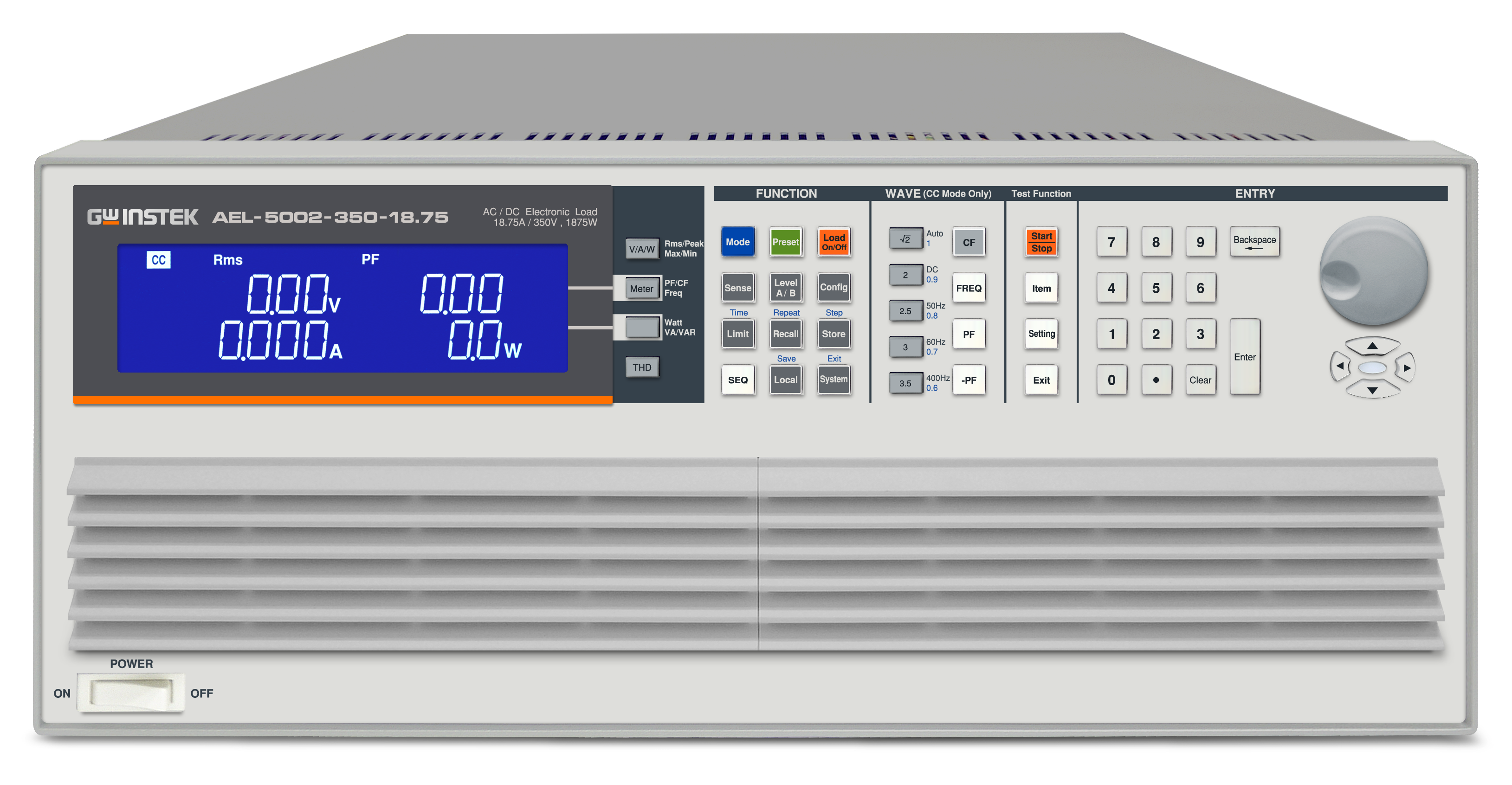
|
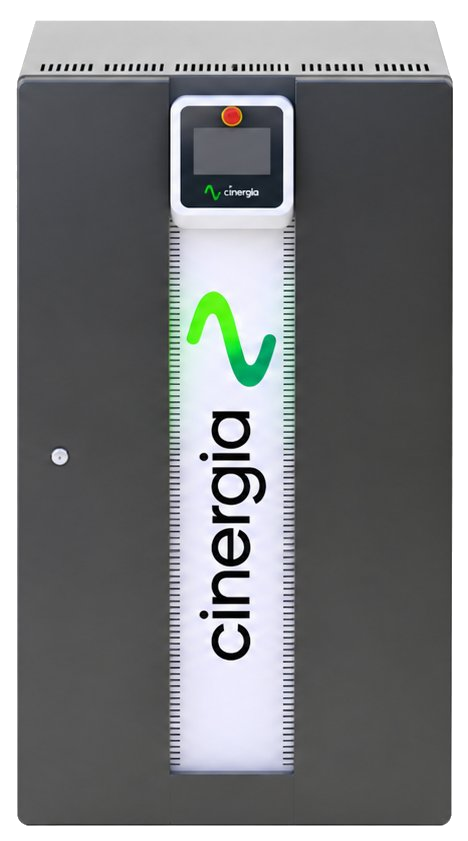
Cinergia EL+20 vAC/DC. This load was added to fill the gap left by the GW Instek. The Cinergia allows the load to be programmed more flexibly, which means the actual voltage-to-current relationship of a measured appliance can be reproduced more precisely than with the GW Instek Load.. It was used for the "sum test" of the inverter test plan, in which the inverter is exposed simultaneously to inrush current, phase shift, THD and transients, in the same combination, magnitude and timing in which they appear in the original measurement. The reproductions shown in the right column of chapter 4 were generated with the Cinergia and form the basis of the sum tests in the technical note. |
4. Waveform Plots
Below are the recorded waveforms for each load, paired with the corresponding reproduction on the Cinergia EL+20 programmable AC load wherever a reproduction was created. The left column shows the original measurement at the customer site; the right column shows the load as it was simulated in the laboratory based on the parameters extracted from that measurement.
The reproductions were generated for the nine loads that were used in the inverter stress tests described in Section IV of the technical note. The aim is qualitative equivalence rather than a sample-by-sample replica: the reproduction matches the original in inrush amplitude and duration, in phase shift, and in the presence and timing of transients, so that the dynamic load can challenge an inverter in a similar way the real appliance would. This is the basis for the test methodology in the technical note, where each reproduced load was used to investigate three questions: can the inverter supply the load, can it supply the load when an inrush current limiter (ICL) is added, and do the loads cause direct failures or long-term stress on the inverter's power electronics.
For each plot, a "Show high-resolution plot" button opens the uncut recording in the highest available resolution in a new tab. The original CSV files behind these plots are available from A2EI on request.
1 – Printer
Startup
|
Measured Signal |
Cinergia Reproduction |
2 – Sewing Machine 1
Startup
|
Measured Signal |
Cinergia Reproduction Not reproduced on Cinergia EL+20
|
Powering
|
Measured Signal |
Cinergia Reproduction Not reproduced on Cinergia EL+20
|
3 – Sewing Machine 2
Startup
|
Measured Signal |
Cinergia Reproduction Not reproduced on Cinergia EL+20
|
Powering
|
Measured Signal |
Cinergia Reproduction Not reproduced on Cinergia EL+20
|
4 – Drill
Startup (Grid)
|
Measured Signal |
Cinergia Reproduction Not reproduced on Cinergia EL+20
|
Powering (Wuze)
|
Measured Signal |
Cinergia Reproduction Not reproduced on Cinergia EL+20
|
5 – Bench Grinder
Startup
|
Measured Signal |
Cinergia Reproduction |
6 – Hair Dryer
Startup
|
Measured Signal |
Cinergia Reproduction Not reproduced on Cinergia EL+20
|
7 – Hair Flat Iron
Constant
|
Measured Signal |
Cinergia Reproduction Not reproduced on Cinergia EL+20
|
9 – Hair Drying Hood
Startup
|
Measured Signal |
Cinergia Reproduction Not reproduced on Cinergia EL+20
|
10 – Hair Curling Iron
Startup
|
Measured Signal |
Cinergia Reproduction Not reproduced on Cinergia EL+20
|
11 – Foot Bath
Startup
|
Measured Signal |
Cinergia Reproduction Not reproduced on Cinergia EL+20
|
12 – Freezer
Startup
|
Measured Signal |
Cinergia Reproduction |
13 – Fridge
Constant
|
Measured Signal |
Cinergia Reproduction Not reproduced on Cinergia EL+20
|
Internal Switch
|
Measured Signal |
Cinergia Reproduction Not reproduced on Cinergia EL+20
|
14 – Gas Oven
Startup
|
Measured Signal |
Cinergia Reproduction Not reproduced on Cinergia EL+20
|
Constant
|
Measured Signal |
Cinergia Reproduction Not reproduced on Cinergia EL+20
|
15 – Bread Slicer
Startup
|
Measured Signal |
Cinergia Reproduction |
Constant
|
Measured Signal |
Cinergia Reproduction Not reproduced on Cinergia EL+20
|
16 – Photo Flash
Startup
|
Measured Signal |
Cinergia Reproduction |
Single Peaks
|
Measured Signal |
Cinergia Reproduction Not reproduced on Cinergia EL+20
|
17 – Towel Heater
Startup
|
Measured Signal |
Cinergia Reproduction Not reproduced on Cinergia EL+20
|
18 – Vacuum Cleaner
Startup
|
Measured Signal |
Cinergia Reproduction |
19 – Air Conditioner (AC)
Grid
|
Measured Signal |
Cinergia Reproduction |
Inverter
|
Measured Signal |
Cinergia Reproduction |
20 – Water Pump
Startup
|
Measured Signal |
Cinergia Reproduction |
21 – Microwave
Startup
|
Measured Signal |
Cinergia Reproduction |
5. Imprint
Published by Access to Energy gGmbH (A2EI) based on data collected by Johannes Hassel, notebook and graphs created by Jacob Frohneberg. Last edited 23.06.2026