
Democratic Republic of Congo
Monitoring clean cooking access for 500,000 households
The cost of cooking with charcoal and biomass
About 95% of households in the Democratic Republic of the Congo (DRC) rely on charcoal and biomass for cooking. The resulting smoke poses serious health risks, especially for women and children, who are often more exposed to cooking fumes. Fuelwood use drives deforestation, putting growing pressure on forests and wildlife.¹
Scaling and monitoring cleaner cooking solutions
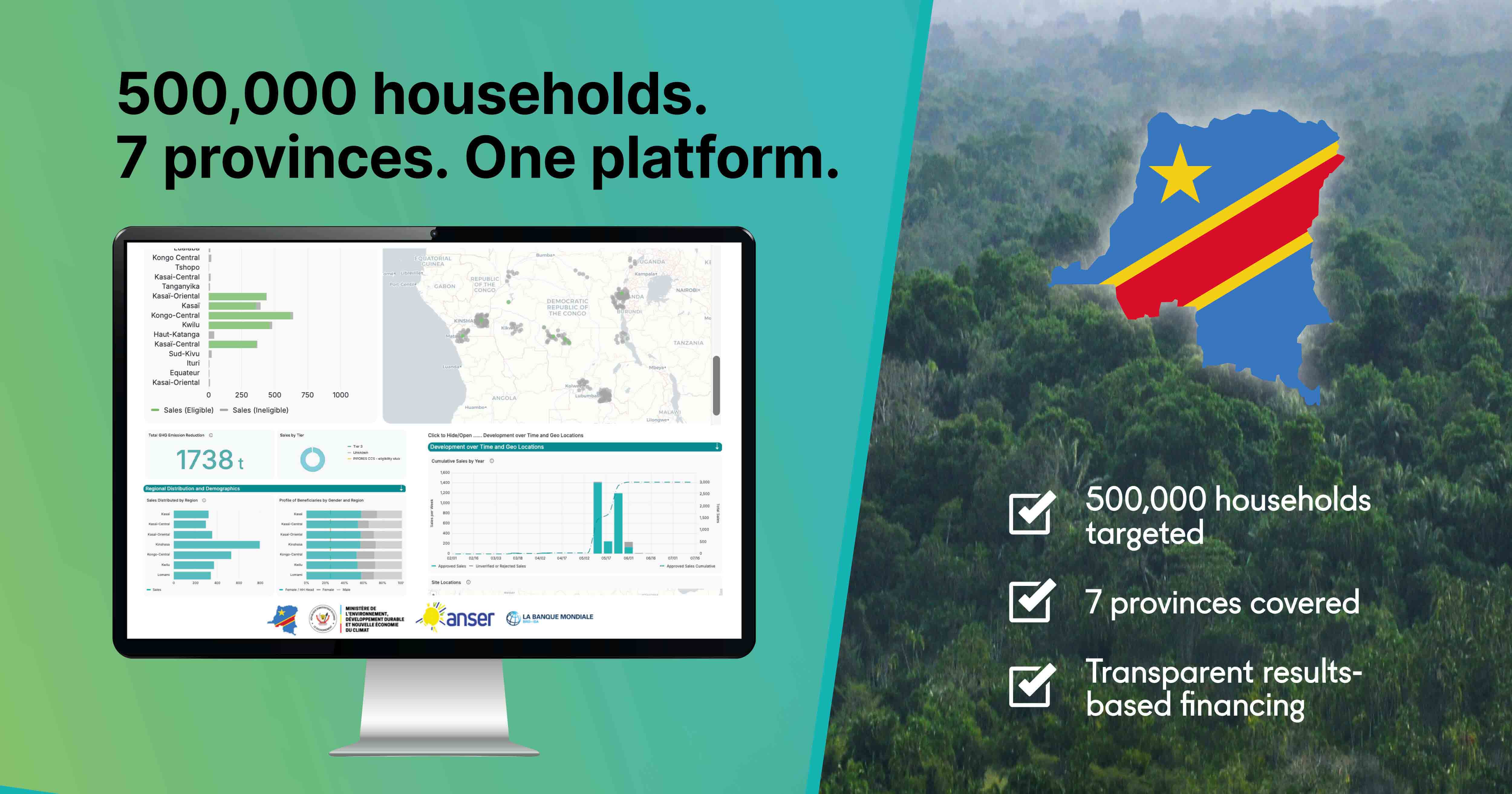
To help meet its commitment to cut fuelwood consumption by 50% by 2035, the DRC government has launched a results-based financing (RBF) program to support the deployment of cleaner cooking methods. Backed by the World Bank, the program aims to reach 500,000 households across seven provinces – Kinshasa, Kongo Central, Kwilu, Kasaï, Kasaï Central, Kasaï Oriental, and Lomami – by 2030. It subsidizes high-efficiency cookstoves supplied by vetted private sector companies.
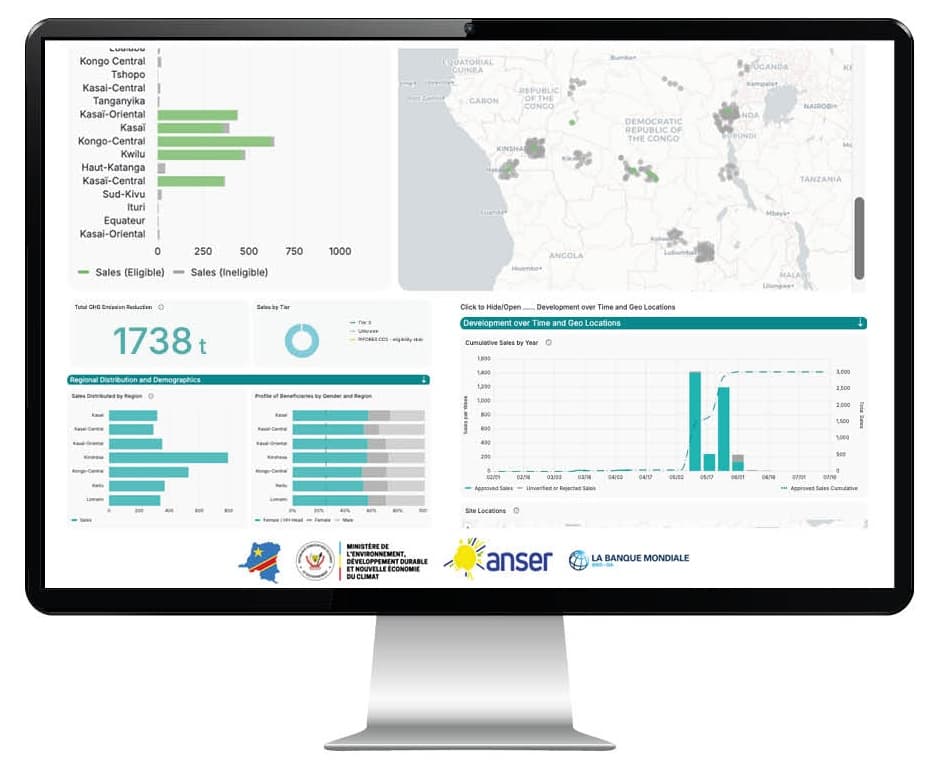
Prospect, the data platform developed by A2EI in cooperation with GET.invest, was selected to customize its data platform as the digital Monitoring, Reporting and Verification (dMRV) platform for the program. The platform was developed in close collaboration with the Forest Investment Program Coordination Unit (UC-PIF) at the Ministry of Environment and Sustainable Development, the National Agency for Electrification and Energy Services in Rural and Peri-urban Areas (ANSER), fund manager GreenMax Capital Group, and the A2EI and Prospect teams.
As the program’s dMRV backbone, Prospect manages the full RBF workflow – from sales reporting and verification to subsidy claims and disbursements. It securely centralizes, verifies, and anonymizes sales, payment, and claims data. Real-time dashboards give government, distributors, fund managers, and financiers visibility into program performance, verification, eligibility, financial flows, and geographic coverage – simplifying reporting and strengthening transparency and trust. End-to-end encryption, controlled key sharing, and role-based access protect sensitive personal data.
Transparency and trust amid infrastructure constraints
The DRC’s vast territory, challenging terrain, limited transport links, and uneven telecommunications coverage make nationwide logistics and coordination difficult. Institutional capacity constraints affect economic growth and access to essential services. Strengthening oversight and promoting transparent procurement and financial management can build public trust and help ensure resources are used effectively.
The Prospect platform supports these goals by connecting operators, verifiers, and program managers in one single platform. Real-time oversight supports data-driven decisions, while integrated PAYGO monitoring and claims management strengthen accountability for results-based payments. Automated workflows and eligibility checks reduce manual work, speed verification, and help accelerate subsidy payments.
Built to scale, the platform uses standardized reporting and transparent data to demonstrate results and help mobilize future climate finance: an important step to support the expansion of clean cooking initiatives across the DRC. Scaling these programs will improve public health while decreasing deforestation pressure on the Congo basin – one of the world’s most biodiverse regions and a vital carbon sink, storing immense amounts of carbon and help regulate the global climate.