
worldwide
Prospect - dMRV as a game changer for energy access

Energy access projects often run on assumptions
Energy access is financed more and more on results: Funders pay once a connection, a solar system or a kilowatt-hour has actually been delivered. Yet the evidence behind these results is often thin, manual or not precise. In other words, often guesswork. The impact of renewable systems is then sized by assumption, savings can’t be quantified, and investors hesitate. Traditional verification doesn’t fix this. It relies on manual surveys, spreadsheets and physical audits that are costly, error-prone and can take one to two years.
#StopGuessing: replacing assumptions with evidence
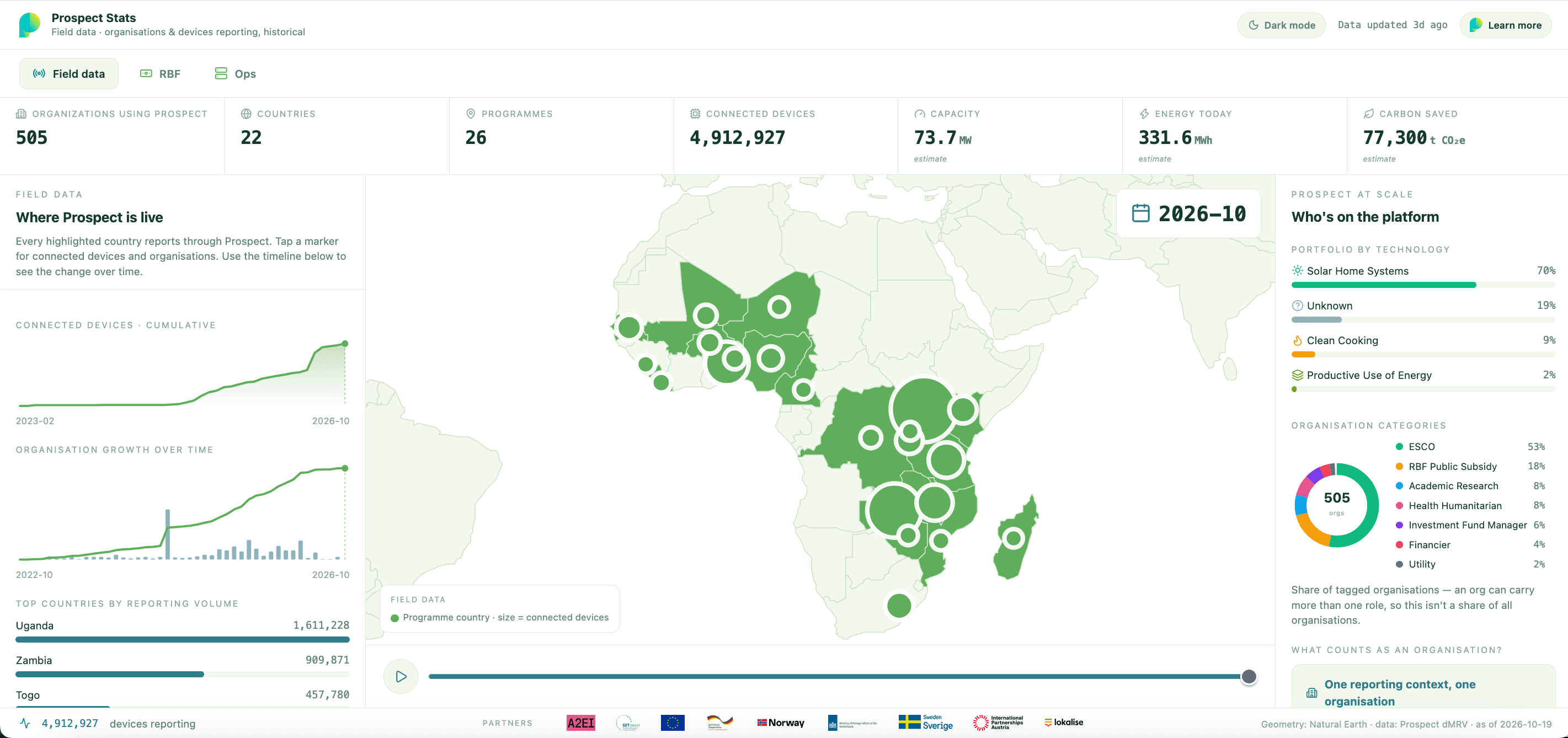
A2EI, with its open source data platform Prospect, supported by GET.invest, puts digital Monitoring, Reporting and Verification (dMRV) at the centre of every energy access project. Smart meters and IoT sensors record energy use, transmit it securely to Prospect, and algorithms calculate consumption, costs and avoided emissions automatically. Dashboards and reports make the results visible to everyone. Prospect also verifies data by triangulation: A “fingerprint” of unique datapoints confirms a new connection, and a “heartbeat” of technical and financial data, such as mobile money transactions, shows that it stays active. Because Prospect is open source and harmonises data from many different meters, programmes can use it without vendor lock-in.
Proof from Uganda
Uganda’s UECCC uses Prospect to manage its USD 140 million results-based financing programme for off-grid solar, clean cooking and productive use.¹ The programme has shown remarkable growth, with over 80 energy companies participating and 800,000 connections to date. Under the original design, 5% of sales were verified by phone and another 5% in the field. With Prospect, energy companies securely share mobile money data for real-time payment verification, and customer ID cards are scanned through the Prospect app. Only claims that cannot be verified digitally need a manual check, which can reduce verification costs by up to 80%. The result is faster subsidy disbursements, less fraud and higher trust in the programme, allowing companies to scale faster.
One data backbone, from design to carbon finance
The same data does more than verify. Metered load profiles show how a site really consumes energy, so solar and storage can be right-sized instead of copied from a template. After installation, the same meters give a continuous before-and-after record of cost per kWh, CO₂ avoided and system uptime. That is the evidence behind ZERO’s uptime guarantees in humanitarian operations² and behind the monitoring of 75 solar-powered health centres in Nigeria.³ Verified digital data also unlocks carbon markets, as standards require it to issue credits, and gives investors the confidence to fund projects with measurable results.
Energy access can’t scale on trust alone. dMRV makes programmes efficient, transparent and accountable and turns every connection into proof. That is why it is a game changer.